# SEO for small business: a 90-day plan you can run yourself
> A small business SEO plan for owners short on time: Business Profile, indexing checks, service pages, reviews, answers and local links, measured by leads.
- URL: https://computese.com/mastering-seo-for-small-business-websites/
- Author: Duong Quan Nguyen, CEO, Computese
- Published: 2024-09-05
- Updated: 2026-09-25
- Topics: SEO
## In short
- Small business SEO is six jobs in order: complete your Google Business Profile, confirm in Search Console that key pages are indexed, give each service and real location a page, then collect reviews, answer customer questions and earn local links.
- Google says the owner of a small local business can probably do much of the work. The tools are free: Business Profile, Search Console and Google Analytics. Hire for redesigns, platform changes and technical problems you cannot explain.
- Measure leads: form submissions, calls and direction requests. Do not judge rankings by searching from your own office, because results depend on who is searching, where and on what device.
- No one can guarantee a #1 ranking on Google. A good provider explains every change, cites Google's documentation, and works with read-only Search Console access and manager access to a profile you own.
- Google's Starter Guide says some changes show in hours and others take several months, so wait a few weeks before judging one. Treat day 90 as the first checkpoint, not the finish line.
SEO for a small business is six jobs done in order: claim and complete your Google Business Profile, check in Search Console that Google indexes your key pages, give every service and real location its own page, collect and answer reviews, answer the questions customers ask, and earn local links. Then measure calls and form leads, not rankings.
This guide is for an owner with a few hours a week and no SEO budget. It sets out the first 90 days with our own time estimates, how to measure the result with free tools, which jobs to hand to a professional, how to judge one, and how long Google says results take. It assumes you have chosen unpaid search as a channel: [Google says it never accepts money](https://developers.google.com/search/docs/fundamentals/do-i-need-seo) to include or rank sites in those results. For a deeper process on an existing site, see [how to improve SEO](https://computese.com/how-to-improve-seo-a-comprehensive-guide/); for page-level fixes, the [SEO checklist for websites](https://computese.com/seo-tips-for-websites-boost-your-online-presence/); for map results in depth, the [local SEO guide](https://computese.com/local-seo/).
## The 90-day plan at a glance
The order matters more than the effort. The first two weeks remove the problems that make everything else wasted work: a profile Google has not verified, pages Google has not indexed. The next weeks build the pages searchers land on, and the last weeks build the reputation that lifts them.
| When | Job | Your time (our estimate) |
| ------------- | ---------------------------------------------------------------------------------- | ------------------------ |
| Week 1 | Verify the site in Search Console; claim, verify and complete the Business Profile | 3 to 5 hours |
| Week 2 | Check key pages are indexed, rewrite titles, test the site on a phone | 3 to 6 hours |
| Weeks 3 to 6 | One page per service and per real location | 2 to 4 hours per page |
| Week 3 onward | Ask every customer for a review; reply to reviews | About 1 hour a week |
| Weeks 6 to 10 | Answer the questions customers ask | 2 to 3 hours per answer |
| Weeks 8 to 13 | Earn local links and mentions | 1 to 2 hours a week |
| Every month | Read Search Console, Google Analytics and profile performance | About 1 hour |
> [!NOTE]
> The times are our estimates, not figures from Google, for a business with one location, five services and four answer pages. They add up to roughly 45 to 75 hours over 13 weeks, about four to six hours a week. More locations or services mean more pages; the order stays the same.
## Week 1: verify your site and claim your Business Profile
Set up the two free Google tools everything else depends on, on the same day, because one can speed up the other: in some cases [Google verifies a Business Profile instantly](https://support.google.com/business/answer/7107242) when the website is already verified in Search Console.
1. **Verify your website in Search Console.** [Search Console is a free Google service](https://support.google.com/webmasters/answer/9128668) that shows how your site appears in Google Search. You do not need it to be listed, but without it you cannot see what Google sees. Choose a [Domain property](https://support.google.com/webmasters/answer/34592): it covers every protocol and subdomain (http, https, www) and is verified with a DNS record at your domain registrar or DNS host.
2. **Add or claim your Business Profile.** Adding or claiming a profile [costs nothing](https://support.google.com/business/answer/2911778). Start at business.google.com/add for a new profile. If Google Maps already shows your business without an owner, open it in Maps and choose to claim it.
3. **Verify it.** Google decides which verification methods you are offered: phone or text, email, a video recording, a live video call or a postcard. Once you finish, Google's review takes up to five business days. Postcard codes mostly arrive within 14 days; do not request a second one while you wait, because that cancels the first.
4. **Complete every field**, following Google's [guidelines for representing your business](https://support.google.com/business/answer/3038177):
- **Name:** the real-world name on your signage, website and stationery, with no city, service or tagline added.
- **Categories:** as few as possible and as specific as possible, describing what the business is rather than what it has.
- **Address or service area:** a location customers can visit, or, if you travel to customers, a service area with the address hidden. P.O. boxes and virtual offices are not eligible.
- **Hours, phone, website and description:** current hours including special hours, and a description of your services without links or promotions.
- **Photos** of the real premises, vehicles and work.
Once the profile is verified, the [Profile Strength tool](https://support.google.com/business/answer/15691556) lists what is still missing.
Google ranks local results on [relevance, distance and prominence](https://support.google.com/business/answer/7091) (the same page also calls the last one popularity), and states that there is no way to request or pay for a better local ranking. You control relevance with complete, accurate details. Distance depends on where the searcher is. Prominence grows with the reviews and links later in this plan. Our [Google Business Profile guide](https://computese.com/google-my-business-seo/) covers categories, suspensions and verification problems in depth.
> [!WARNING]
> Adding a city or keywords to the business name breaks Google's guidelines and can get the profile suspended. Put the city in the address or service area, and the services in the categories and description.
## Week 2: fix the basics that stop Google
A page Google has not indexed cannot rank, however good it is. For a small site, three checks cover the usual blockers.
### Check that your key pages are indexed
Paste your home page address into the [URL Inspection tool](https://support.google.com/webmasters/answer/9012289) in Search Console, then each service page. It reports whether the URL is on Google and, if not, why; a live test shows whether the current version could be indexed, and once a problem is fixed you can request indexing. For a site with fewer than 500 pages, Google says you [probably do not need the Page indexing report](https://support.google.com/webmasters/answer/7440203): checking key pages directly is enough. A few unindexed URLs are normal when they are duplicates, removed pages or pages blocked on purpose. What is not normal is a service page held back by a stray `noindex` tag or a robots.txt rule, which the inspection result names. For how discovery works, see [web crawling and indexing explained](https://computese.com/web-crawling-and-indexing-explained/).
### Write a clear title for every important page
Google builds each result's [title link](https://developers.google.com/search/docs/appearance/title-link) automatically from several sources, including the page's `` element, its main visible title and its headings. Give every page a title that is unique, descriptive and concise: not a vague "Home", not the same boilerplate on every page, not a list of keywords. The [SEO Starter Guide](https://developers.google.com/search/docs/fundamentals/seo-starter-guide) suggests including the business name and, where it helps, its location:
```html
<title>Water heater repair in Riverside | Example Plumbing
```
Most content management systems turn the title you type into the `` element, so this is usually a form field, not code. Start with the home page and the service pages, the pages you want customers to land on.
### Make sure the site is fast on a phone
Google uses [mobile-first indexing](https://developers.google.com/search/docs/crawling-indexing/mobile/mobile-sites-mobile-first-indexing): it indexes and ranks the version of your content that its smartphone crawler sees. The mobile layout must carry the same text, photos and contact details as the desktop one. Speed and stability are measured by [Core Web Vitals](https://developers.google.com/search/docs/appearance/core-web-vitals), and Google's targets for a good experience are Largest Contentful Paint within 2.5 seconds, Interaction to Next Paint under 200 milliseconds and Cumulative Layout Shift under 0.1.
Test the home page and one service page in [PageSpeed Insights](https://developers.google.com/speed/docs/insights/v5/about). It shows field data from real Chrome users when a page or site has enough of them, and lab data from a simulated load every time. A new or quiet site may have too little real-user data, so the lab result and a test on your own phone over mobile data are what you have. If the cause is a heavy theme, oversized images or a slow host, the fix is developer work. The [SEO checklist](https://computese.com/seo-tips-for-websites-boost-your-online-presence/) covers HTTPS, canonical URLs and sitemaps if these checks turn up more.
## Weeks 3 to 6: give each service and each real location its own page
Someone searching for boiler repair wants a page about boiler repair, not a home page that lists every trade you offer. One page per service lets each page answer one kind of search completely, and the same rule applies to places.
For each service page, cover what a customer needs to decide:
- what the service includes, and what it does not;
- the areas you cover and how soon you can come;
- how pricing works: a range, a call-out fee, or what a quote depends on;
- photos of your own work, and who does it;
- the questions customers ask before they book;
- one clear way to get in touch: a phone number, a form or a booking link.
Write it from experience. Google's guidance on [people-first content](https://developers.google.com/search/docs/fundamentals/creating-helpful-content) asks whether a page shows first-hand expertise, such as having actually done the work, and whether a reader leaves knowing enough to reach their goal.
Make a location page only for a place that is real: a branch customers visit, or a town you genuinely serve and have something specific to say about, such as the jobs you do there or how quickly you get there. Google's [spam policies](https://developers.google.com/search/docs/essentials/spam-policies) list, as doorway abuse, pages targeted at specific regions or cities that funnel users to one page, and substantially similar pages that sit closer to search results than to a browsable site structure. Ten city pages with only the town name swapped fit that description.
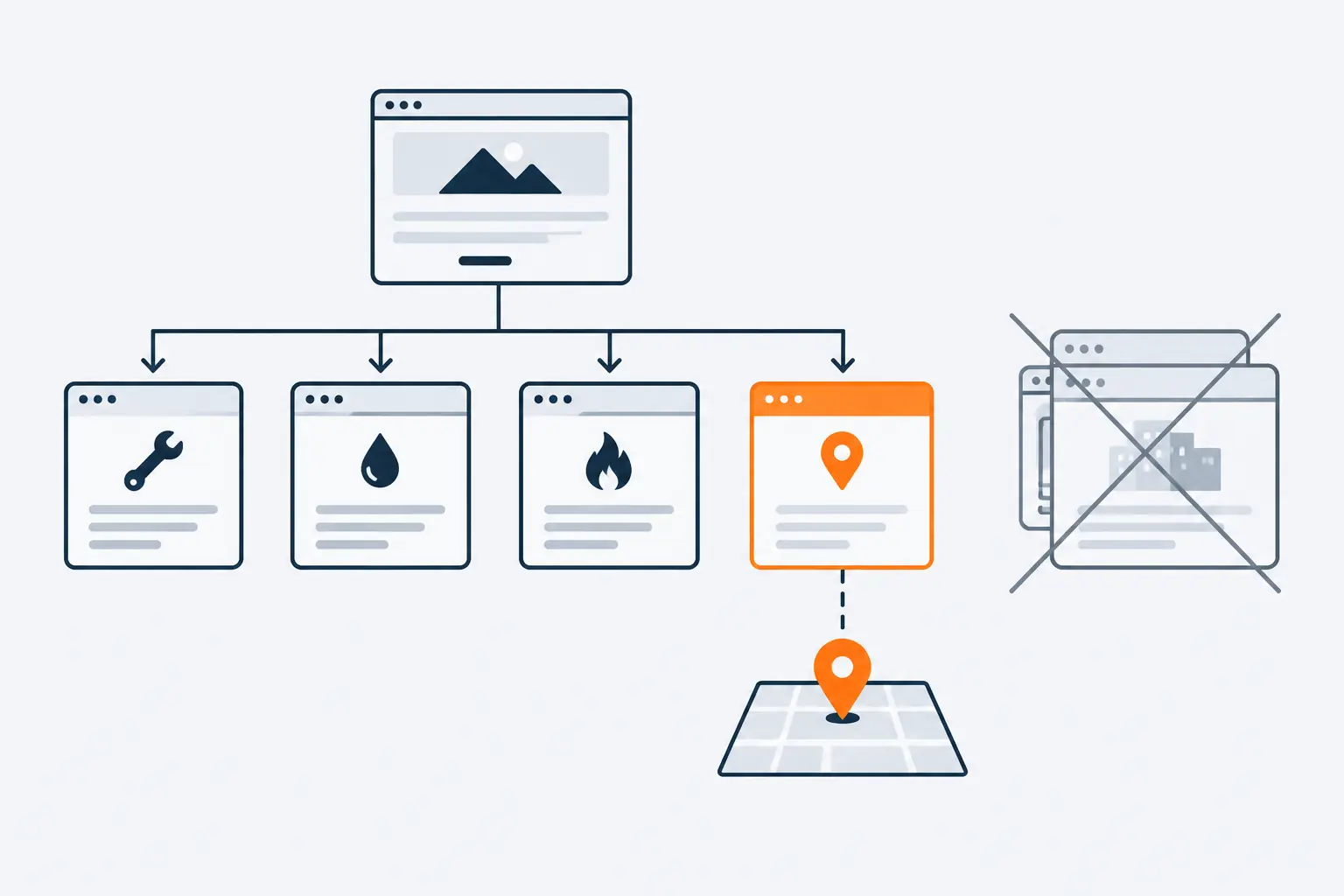
*One page per real service and place gives each search a complete answer; copies that differ only by the town name are what Google calls doorway abuse.*
Link every service and location page from your main navigation or a services page, and point the website field of each Business Profile at the matching location page. Consistent name, address and phone across directories, and LocalBusiness structured data, are covered in the [local SEO guide](https://computese.com/local-seo/).
## From week 3: collect and answer reviews within Google's rules
Reviews do two jobs: they help the next customer decide, and Google says more reviews and positive ratings [can help your local ranking](https://support.google.com/business/answer/7091). That only works while the reviews are genuine, and Google's rules on asking for them are strict.
**Ask every customer, the same way.** Google's [review tips](https://support.google.com/business/answer/3474122) suggest sending customers a review link or QR code. You [create both in the profile](https://support.google.com/business/answer/16816815) (the QR code only from a computer browser, as of September 2026), and Google suggests putting them where the job ends: on receipts, in thank-you emails, at the end of a chat. A customer needs to be signed in to a Google Account to leave a review.
**Stay inside the policy.** Google's [Maps content policy](https://support.google.com/contributionpolicy/answer/7400114) removes fake engagement and rating manipulation, and does not allow a business to:
- offer anything for a review, such as payment, a discount or a free product, or for changing or removing a negative one;
- discourage negative reviews, or ask only the customers it expects to be happy (review gating);
- give staff review quotas, or ask them to collect reviews that mention them by name;
- pressure customers to review while on the premises, or tell them what to write;
- post reviews from employees, relatives or anyone else with a conflict of interest.
> [!WARNING]
> A discount in exchange for a review breaks the rule even when the review is honest. Google calls incentives for reviews strictly prohibited and removes the reviews they produce.
**Reply to the reviews you can add something to.** Google's tips are practical: be polite and brief, make each reply specific rather than a stock thank-you, do not use replies to promote offers, never share a reviewer's private details, and when a complaint is fair, acknowledge the mistake, explain what you can and cannot do, and offer to continue by phone or email. Replies are public, so write them for the next customer as much as for the reviewer.
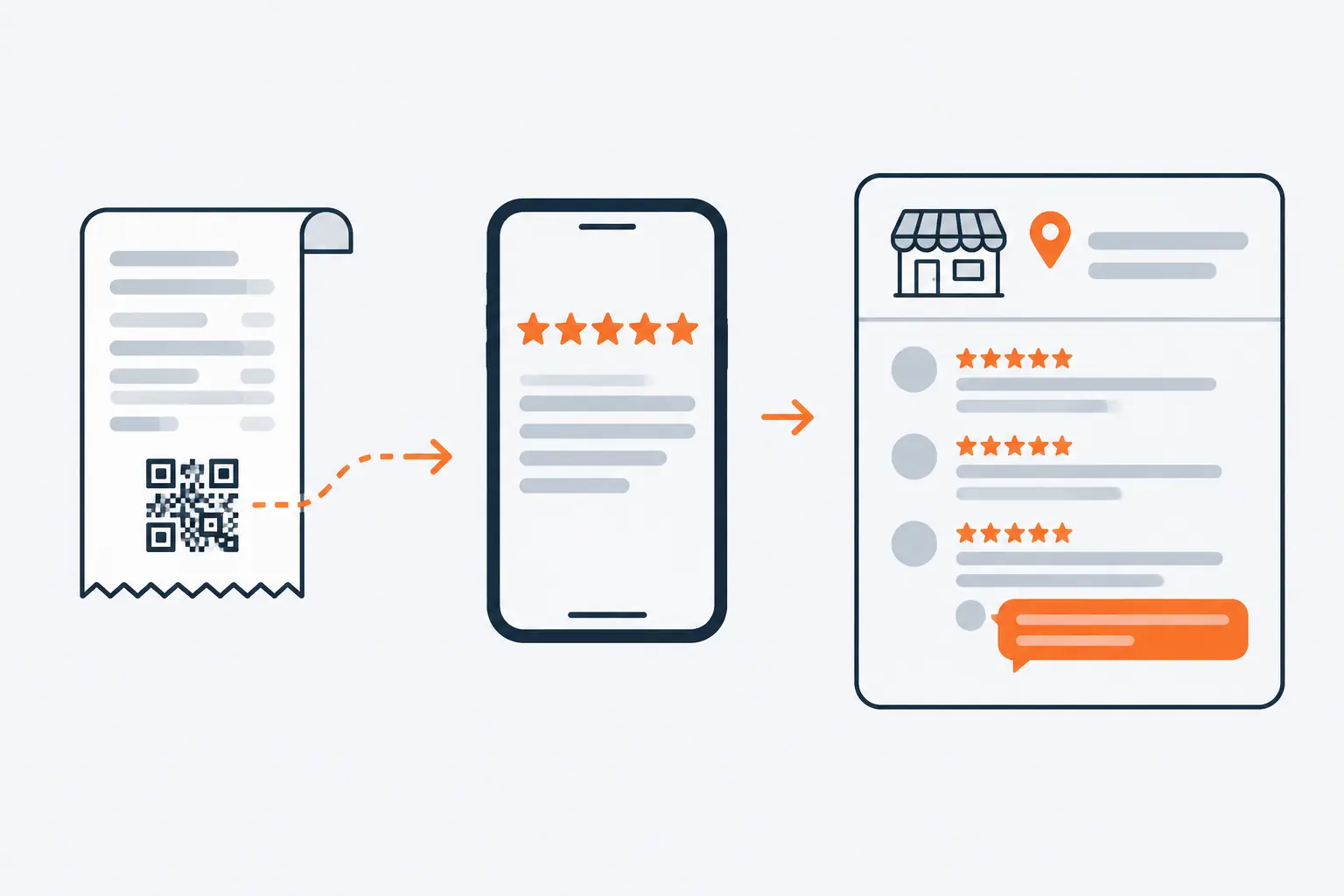
*The same link for every customer keeps requests within Google's rules, and the reply is public, so it is written for the next customer too.*
## Weeks 6 to 10: write answers to the questions customers actually ask
The questions people ask you on the phone are the searches you want to be found for. Collect them for two weeks before writing anything:
- questions from calls, emails, quotes and chats, written down in the customer's own words;
- the queries in Search Console's [Performance report](https://support.google.com/webmasters/answer/7576553), which lists the searches that already show your site, with clicks and impressions for each;
- the search terms in your Business Profile's [performance report](https://support.google.com/business/answer/9918094), updated at the start of each month.
Then give each substantial question an answer, as a short page or a section of a service page, with the answer in the first sentence followed by what it depends on:
| Question customers ask | Where the answer goes |
| --------------------------------- | ------------------------------------------------------------------------- |
| How much does it cost? | The service page: how pricing works and what changes the price |
| Do you cover my town? | The service area on the location page |
| How long does the job take? | The service page, or a short answer page linked from it |
| Should I repair or replace it? | An answer page that sets out the trade-offs, linked from the service page |
| What should I do before you come? | A preparation page, linked from booking confirmations |
Google's [people-first content guidance](https://developers.google.com/search/docs/fundamentals/creating-helpful-content) is the test to apply: would your existing customers find the page useful if they came to you directly, and does it show you have done the work? Google also says it has no preferred word count, so write until the question is answered, then stop.
The same work covers AI search. Google says there are [no additional requirements](https://developers.google.com/search/docs/appearance/ai-features) to appear in AI Overviews or AI Mode beyond normal SEO best practices; our post on [AI Overviews in Search](https://computese.com/ai-overviews-in-search/) explains how they choose sources.
## Weeks 8 to 13: earn local links and mentions
Prominence, the third local ranking factor, is based partly on [how many websites link to your business](https://support.google.com/business/answer/7091). For a small business, the links worth having come from organizations that already know you:
- suppliers and manufacturers that list their dealers or installers;
- trade associations, licensing bodies' member directories and the local chamber of commerce;
- local news, when you have something real to report, such as an opening, an apprenticeship or a community project;
- clubs, schools and events you support, where the value is the mention and the visitors rather than ranking credit, because a sponsorship link is a paid link and should be marked as one;
- partners you genuinely work with, such as the electrician a builder recommends.
Offline promotion counts too. The [SEO Starter Guide](https://developers.google.com/search/docs/fundamentals/seo-starter-guide) calls word of mouth one of the most effective and lasting ways to promote a site, lists community engagement among the ways to earn it, and suggests putting your web address on business cards, letterhead and posters.
What not to do: Google's [spam policies](https://developers.google.com/search/docs/essentials/spam-policies) treat buying links, trading goods or services for links, excessive link swaps, automated link building and low-quality directory links as link spam. Sponsorship and advertising links are allowed when they carry `rel="sponsored"` or `rel="nofollow"`. For the wider method, see [how to do link building](https://computese.com/how-to-do-link-building-for-seo/) and [what backlinks are](https://computese.com/what-are-backlinks-for-seo/).
## Measure results with free tools
Measure what the business needs, which is leads, and read the search data as the explanation. Three free tools cover it, and a monthly look at each is enough:
| Tool | What it tells you | What it cannot tell you |
| --------------------------------- | ---------------------------------------------------------------------------------------------------------- | ---------------------------------------------------------------- |
| Search Console Performance report | Clicks, impressions, click-through rate and average position, by query and by page | What visitors did after they arrived |
| Google Analytics 4 | What visitors do on the site, including form starts, form submissions and other key events | The searches that showed your site but earned no click |
| Business Profile performance | Views, search terms, calls, direction requests, website clicks, messages and bookings from Search and Maps | Which actions came from unpaid results: it counts Google Ads too |
[Google Analytics is free of charge](https://marketingplatform.google.com/about/analytics/), like the other two. Search Console reports what happened before someone reached your site, and Google Analytics reports what they did after, which is why Google suggests [using the two together](https://developers.google.com/search/docs/monitor-debug/google-analytics-search-console). Expect the numbers to differ: a Search Console click and an Analytics session are counted differently.
Set up lead tracking once:
1. **Install Google Analytics on every page.** It [measures form interactions automatically](https://support.google.com/analytics/answer/12941105) with the `form_start` and `form_submit` events.
2. **[Mark the form submission as a key event](https://support.google.com/analytics/answer/13128484)**, so reports count leads separately from visits. A tap on your phone number can be counted the same way, as an event your developer or tag manager sets up.
3. **[Link your Business Profile to Google Analytics](https://support.google.com/business/answer/16987554)** under Admin, Product links, Google Business Profile links, so calls, direction requests and website clicks from the profile appear beside the site data.
4. **Ask every new customer how they found you, and write it down.** A customer who taps the call button on your profile may never visit the site at all.

*Rankings are a means: count the calls and form submissions that search sends you, because those are what the work is for.*
Do not judge rankings by searching from your office. Search Console notes that results depend on the time, place, device and recent history of the person searching, so your own search tells you little about a customer's.
## What to do yourself, and what to hire for
Google's advice is direct: if you [run a small local business](https://developers.google.com/search/docs/fundamentals/do-i-need-seo), you can probably do much of the work yourself, starting with its SEO Starter Guide. It also names the best time to hire: when you are planning a redesign or a new site, and the earlier the better.
| Job | Do it yourself | Get help when |
| ------------------------------------- | -------------------------------------- | ---------------------------------------------------------------------------------- |
| Business Profile | Yes: nobody knows the business better | Verification keeps failing, the profile is suspended, or you run several locations |
| Reviews and replies | Yes: replies should sound like you | Rarely |
| Service pages and answers | Yes, or dictate them to a writer | You need an editor to turn notes into clear pages |
| Indexing checks | Yes: URL Inspection is point and click | Pages stay unindexed for reasons you cannot explain |
| Speed on a phone | Measure it yourself | The fix means changing the theme, images, code or hosting |
| Redesign, new platform or domain move | No | Always: every old URL needs a redirect decision before launch |
| Local links | Yes: they come from your relationships | Rarely |
If you want that help, our [SEO service](https://computese.com/services/seo/) starts with a technical SEO audit: a crawl of the whole site, a read of Search Console and, where you have them, your server logs, ending in issues ranked by impact and effort and a 90-day plan. It includes local search profiles for businesses that serve an area, and it excludes guaranteed rankings, because no one can promise them honestly. When the site itself is slow or hard to edit, that is [web design and development](https://computese.com/services/web-design-development/) work, where Core Web Vitals and search are written into the definition of done.
## How to judge an SEO provider
Google's page [Do you need an SEO?](https://developers.google.com/search/docs/fundamentals/do-i-need-seo), revised in June 2026, is a short and useful checklist. Ask any provider:
- to show examples of previous work and results;
- whether they follow Google Search Essentials;
- what results they expect, by when, and how they will measure them;
- what experience they have in your industry and your city;
- whether they will share every change they make to your site, and why;
- whether they cite Google's documentation for their recommendations, and whether their advice on AI search (sold as AEO or GEO) matches Google's guidance.
A good provider asks questions back: what makes the business different, who the competitors are, and how customers find you now.
Walk away from:
- **a guarantee.** In Google's words, "No one can guarantee a #1 ranking on Google." Its [guidance on third parties](https://support.google.com/business/answer/7163406) adds that they cannot promise or directly influence where a business appears on Search or Maps;
- claims of a special relationship with Google, or a priority submission service;
- unsolicited emails offering to get you listed;
- any requirement to link to them from your site, which you should never have to do;
- talk of link schemes, or of submitting your site to thousands of search engines;
- secrecy about what they will change.
Keep control of your accounts:
1. For an audit, give Search Console read access only: add the provider as a [restricted user](https://support.google.com/webmasters/answer/7687615), which has view rights to most data, rather than a full user, which can also take some actions.
2. Keep the business as the Business Profile owner and add the provider as a manager. Only owners control who has access, and they can change it at any time.
3. Work with one provider at a time on the profile. Your business appears on Google once, so two providers cannot be tested side by side.
4. Get a written agreement that details the services and their costs.
5. Review the profile's performance yourself every month.
You remain responsible for what a provider does for you: Google warns that deceptive or misleading content created by an SEO can get a site removed from its index.
## How long small business SEO takes
Some parts are quick, and most of them sit in the first two weeks of this plan:
- **Business Profile verification:** up to five business days of review after you complete the steps, plus postal time if you verify by postcard.
- **A page you ask Google to recrawl:** [crawling can take a few days to a few weeks](https://developers.google.com/search/docs/crawling-indexing/ask-google-to-recrawl), and a request does not guarantee the page will be included in results.
- **Title changes:** Google has to [recrawl and reprocess the page](https://developers.google.com/search/docs/appearance/title-link) before a new title can show, which also takes a few days to a few weeks.
- **Reviews and links:** they build at the pace of your customers and your relationships.
For everything else, Google's current estimate, in the [SEO Starter Guide](https://developers.google.com/search/docs/fundamentals/seo-starter-guide), is that some changes take effect in a few hours and others take several months, and that you should generally wait a few weeks before judging whether a change helped. An older figure is still quoted widely: until its June 2026 revision, Google's hiring page said results [typically took four months to a year](https://web.archive.org/web/20260301031656/https://developers.google.com/search/docs/fundamentals/do-i-need-seo) from the first changes. The [current version](https://developers.google.com/search/docs/fundamentals/do-i-need-seo) gives no range.
In practice, treat day 90 as the first checkpoint, not the finish line. Compare leads, calls and Search Console impressions with the month before you started, then keep the routine going: reviews every week, an answer page a month, a monthly look at the three reports, and an SEO check before any redesign. From there, the [process for improving an existing site](https://computese.com/how-to-improve-seo-a-comprehensive-guide/) takes over.
## Key terms
- **Google Business Profile**: Google's free listing for a business, which controls how it appears in Google Maps and in the local results on Google Search. It must be claimed and verified before you can edit it.
- **Google Search Console**: Google's free service for monitoring a site in Google Search: which queries show it, which pages are indexed, and what stops the others.
- **URL Inspection tool**: The Search Console tool that reports whether Google has indexed a specific URL and why not, tests the live page, and lets you request indexing.
- **Title link**: The clickable headline of a search result. Google builds it automatically, using the page's title element, its main visible title and headings among other sources.
- **Mobile-first indexing**: Google indexes and ranks the version of a page that its smartphone crawler sees, so the mobile page must carry the full content.
- **Core Web Vitals**: Three measures of real users' experience: Largest Contentful Paint for loading, Interaction to Next Paint for responsiveness and Cumulative Layout Shift for visual stability.
- **Prominence**: How well known Google judges a business to be, one of its three local ranking factors with relevance and distance. Links from other websites and reviews feed into it.
- **Doorway abuse**: Pages made to rank for similar searches, such as one per city, that funnel visitors to one page or barely differ from each other. Google's spam policies prohibit it.
- **Review gating**: Asking only the customers you expect to be happy for a review, or discouraging negative ones. Google's Maps content policy does not allow it.
- **Key event**: A Google Analytics event you mark as important to the business, such as a submitted contact form, so reports count it separately from ordinary visits.
## Common questions
### Can I do SEO for my small business myself?
Mostly, yes. Google's own guidance says that if you run a small local business, you can probably do much of the work yourself, starting with its SEO Starter Guide. Get help for a redesign or platform change, indexing problems you cannot explain, and speed fixes that need a developer.
### How long does SEO take for a small business?
A Business Profile is usually verified within five business days, and a page you ask Google to recrawl can take a few days to a few weeks. For the rest, Google's Starter Guide says changes take from a few hours to several months, and suggests waiting a few weeks before judging one. Treat day 90 as the first checkpoint.
### How much does SEO cost for a small business?
Google's tools cost nothing: Business Profile, Search Console and Google Analytics are free, and Google never accepts money to include or rank sites in its unpaid results. The real cost is time, which we estimate at four to six hours a week for this plan, or a provider's fee. If you hire, get a written agreement that lists the services and their costs.
### Can an SEO company guarantee a first-page ranking?
No. Google states that no one can guarantee a #1 ranking, and that third parties cannot promise or directly influence where a business appears on Search or Maps. Treat a guarantee, a claimed special relationship with Google or a priority-submission offer as a reason to walk away.
### Does AI search change SEO for a small business?
Not the fundamentals. Google says there are no additional requirements or special optimizations for appearing in AI Overviews or AI Mode beyond normal SEO best practices. Indexed pages that answer real customer questions clearly serve both.
### What should a small business do first for SEO?
Verify your website in Search Console and claim your Google Business Profile on the same day: in some cases Google verifies a profile instantly when the website is already verified in Search Console. Then complete every field of the profile and check that your home page and service pages are indexed.
## Sources
1. [Do you need an SEO?](https://developers.google.com/search/docs/fundamentals/do-i-need-seo), Google Search Central
2. [Verify your business on Google](https://support.google.com/business/answer/7107242), Google Business Profile Help
3. [About Search Console](https://support.google.com/webmasters/answer/9128668), Google Search Console Help
4. [Add a website property to Search Console](https://support.google.com/webmasters/answer/34592), Google Search Console Help
5. [Add or claim your Business Profile](https://support.google.com/business/answer/2911778), Google Business Profile Help
6. [Guidelines for representing your business on Google](https://support.google.com/business/answer/3038177), Google Business Profile Help
7. [Manage your Profile Strength](https://support.google.com/business/answer/15691556), Google Business Profile Help
8. [Tips to improve your local ranking on Google](https://support.google.com/business/answer/7091), Google Business Profile Help
9. [URL Inspection tool](https://support.google.com/webmasters/answer/9012289), Google Search Console Help
10. [Page indexing report](https://support.google.com/webmasters/answer/7440203), Google Search Console Help
11. [Influencing your title links in search results](https://developers.google.com/search/docs/appearance/title-link), Google Search Central
12. [Search Engine Optimization (SEO) Starter Guide](https://developers.google.com/search/docs/fundamentals/seo-starter-guide), Google Search Central
13. [Mobile site and mobile-first indexing best practices](https://developers.google.com/search/docs/crawling-indexing/mobile/mobile-sites-mobile-first-indexing), Google Search Central
14. [Understanding Core Web Vitals and Google search results](https://developers.google.com/search/docs/appearance/core-web-vitals), Google Search Central
15. [About PageSpeed Insights](https://developers.google.com/speed/docs/insights/v5/about), Google for Developers
16. [Creating helpful, reliable, people-first content](https://developers.google.com/search/docs/fundamentals/creating-helpful-content), Google Search Central
17. [Spam policies for Google web search](https://developers.google.com/search/docs/essentials/spam-policies), Google Search Central
18. [Tips to get more reviews](https://support.google.com/business/answer/3474122), Google Business Profile Help
19. [Create a Google link or QR code to request reviews](https://support.google.com/business/answer/16816815), Google Business Profile Help
20. [Prohibited & restricted content](https://support.google.com/contributionpolicy/answer/7400114), Maps User Generated Content Policy Help
21. [Performance report (Search results): Overview and basic setup](https://support.google.com/webmasters/answer/7576553), Google Search Console Help
22. [Understand your Business Profile performance & insights](https://support.google.com/business/answer/9918094), Google Business Profile Help
23. [AI features and your website](https://developers.google.com/search/docs/appearance/ai-features), Google Search Central
24. [Google Analytics](https://marketingplatform.google.com/about/analytics/), Google Marketing Platform
25. [Using Search Console and Google Analytics data for SEO](https://developers.google.com/search/docs/monitor-debug/google-analytics-search-console), Google Search Central
26. [[GA4] How to generate more leads on your website](https://support.google.com/analytics/answer/12941105), Google Analytics Help
27. [Mark events as key events](https://support.google.com/analytics/answer/13128484), Google Analytics Help
28. [Connect your Business Profile to Google Analytics](https://support.google.com/business/answer/16987554), Google Business Profile Help
29. [Tips for working with third parties to manage your Business Profile](https://support.google.com/business/answer/7163406), Google Business Profile Help
30. [Managing owners, users, and permissions](https://support.google.com/webmasters/answer/7687615), Google Search Console Help
31. [Ask Google to recrawl your URLs](https://developers.google.com/search/docs/crawling-indexing/ask-google-to-recrawl), Google Search Central
32. [Do you need an SEO? (archived copy, March 1, 2026)](https://web.archive.org/web/20260301031656/https://developers.google.com/search/docs/fundamentals/do-i-need-seo), Internet Archive